
Autonomous software may be new, but states already have familiar tools for deciding when digital activity becomes taxable presence.
An artificial intelligence agent does not need a desk, a company badge, or a W-2 to change a taxpayer’s state tax profile. It may answer customer questions, negotiate terms, approve transactions, monitor equipment, issue refunds, arrange delivery, or transmit a software fix. Each task can occur in seconds and at national scale. The state tax question, however, is not whether the agent is a person. It is whether the business, through the agent, is conducting an activity that a state may tax.
That distinction matters. The Supreme Court’s decision in South Dakota v. Wayfair, Inc. rejected a physical-presence requirement for sales tax nexus and recognized that an Internet seller can be present in a state in a meaningful way without traditional physical presence.[1] Although Wayfair addressed sales tax, its practical message has influenced the broader state tax conversation: a business cannot assume that activity is outside a state simply because its employees and headquarters are elsewhere.
The old rules still ask the right first question
For income and franchise tax, nexus is still determined under constitutional limits, state statutes and regulations, and any applicable federal protection. Many states impose filing obligations based on in-state receipts or other economic contacts, even without employees or owned property in the state. New Jersey, for example, currently treats a corporation as having substantial nexus for its Corporation Business Tax when it has more than $100,000 of New Jersey-source receipts or at least 200 transactions delivered to New Jersey customers during the year.[2]
An AI agent can make those thresholds easier to cross because it expands the volume, frequency, and reach of customer interactions. The bot is not a separate taxpayer. Its activity is part of the business activity of the company that deploys it. The relevant facts include what the agent is authorized to do, whose systems it uses, which customers or assets it interacts with, where related property is located, and how the resulting revenue is sourced.
The better question is not “Where is the AI?” It is “What business function is being performed, for whom, and where does state law treat that activity or revenue as occurring?”
P.L. 86-272 is where the thought experiment becomes practical
Public Law 86-272 can prevent a state from imposing a net income tax when a company’s only in-state business activity is soliciting orders for tangible personal property, the orders are approved outside the state, and approved orders are filled from outside the state.[3] The protection is narrow. It does not generally cover services, software or other intangible property, and it does not prevent non-income-based taxes or every filing obligation.
The Multistate Tax Commission’s 2021 revised statement applies that framework to Internet activity. It treats static product information and a conventional online ordering process more favorably, but identifies several interactive activities as unprotected, including regular post-sale chat support, remote fixes or upgrades, certain uses of cookies, and marketplace inventory in a customer’s state.[4]
States are putting similar concepts into their own rules and guidance. New York’s corporate tax regulations address activities conducted through the Internet and state that interactive customer activity can go beyond solicitation; its examples include post-sale assistance, cookies used for non-solicitation business functions, remote product fixes, extended warranties, and in-state marketplace inventory.[5] New Jersey’s June 2026 nexus bulletin likewise lists
electronic post-sale assistance, remote repairs or upgrades, subscription services, and certain Internet-connected business services among activities that can exceed P.L. 86-272 protection.[2]
This creates a direct AI-agent issue. The U.S. Government Accountability Office has used customer service to explain the difference between generative AI and an AI agent: a conventional system may answer an order-status question, while an agent may interact with other systems to process a return or exchange.[6] Under the MTC approach and the cited state rules, that functional step—from providing information to performing a post-sale business activity—can be the step that jeopardizes federal income-tax immunity.
The function matters more than the label
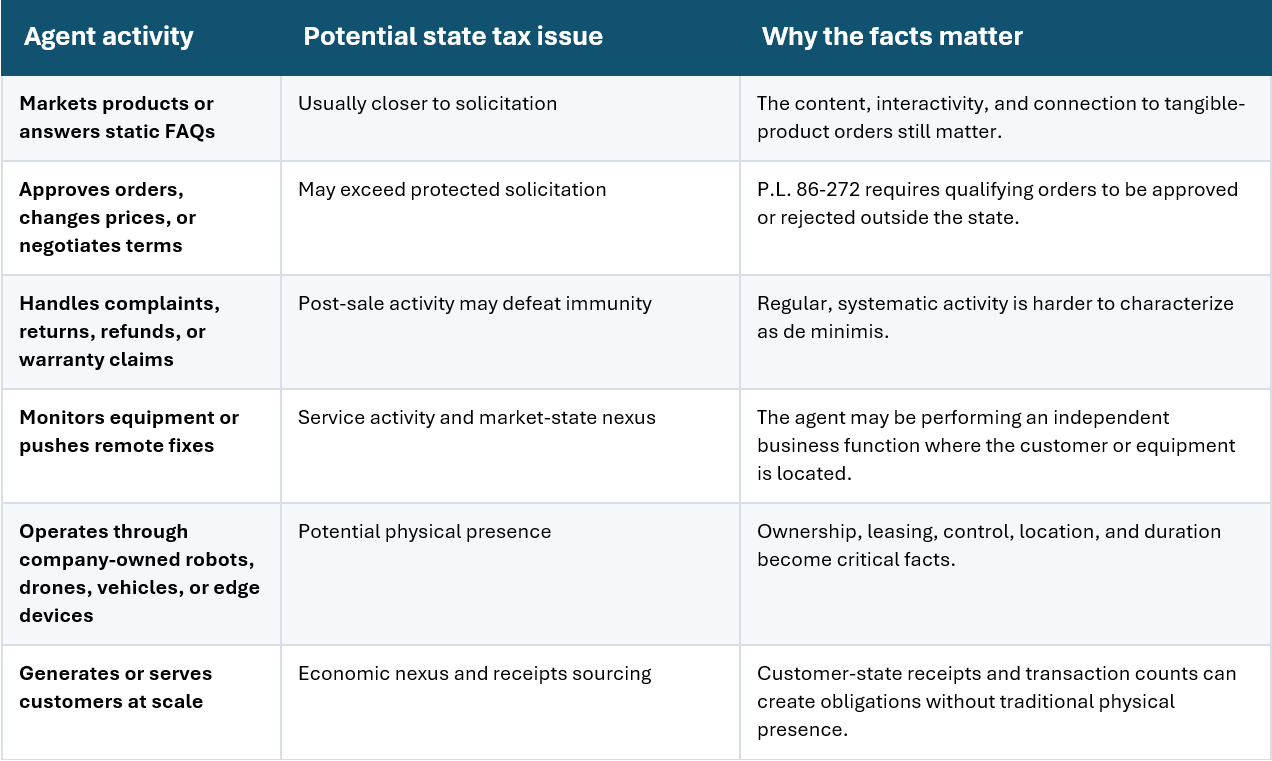
Nexus is only the first state tax question
Once an AI-enabled business has nexus, the analysis shifts to tax base and apportionment. Many states source service and digital receipts to the customer’s market or the place where the benefit is received. An agent may therefore create two changes at once: it can increase the company’s contacts with a state and generate more receipts assigned to that same state. The result may affect filing obligations, apportionment percentages, throwback or throwout positions, combined-report membership, and estimated payments.
Infrastructure also deserves a separate review. A company may use a third-party cloud platform without knowing the exact server that processed a task, while another deployment may involve dedicated servers, customer-installed software, leased equipment, or company-owned devices. Those arrangements should not be collapsed into a single “cloud” category. Contracts, asset ledgers, system architecture, and vendor terms may lead to different state tax conclusions.
A practical control framework
Tax departments do not need to understand every model parameter. They do need a reliable map of what each agent can do. Before an AI agent moves from pilot to production, businesses should:
• Inventory each agent, its owner, its purpose, and the legal entity that earns the related revenue.
• Separate pre-sale solicitation from order acceptance, fulfillment, post-sale service, returns, collections, repairs, and warranty work.
• Identify the states of customers, users, equipment, inventory, employees, contractors, and company-controlled hardware.
• Review whether the agent can create contracts, change commercial terms, issue credits, dispatch property, or transmit code to customer devices.
• Track state receipts and transaction thresholds using the same sourcing rules applied on the return.
• Preserve system logs and governance records that show what the agent actually did during the tax year.
• Require tax review when a software update adds a new customer-facing or asset-control function.
There is not yet a special nexus rule that turns on whether software is called an “AI agent.” Existing rules already focus on business activity conducted by or on behalf of a taxpayer. As agents become more autonomous, the factual record will become more important, not less. A company that documents only where its people sit may miss the activities its systems perform in customer markets every day.
So, will an AI agent create nexus? Sometimes. The answer will turn less on the technology’s name than on the job the business assigned to it, the states touched by that job, and the revenue and property connected to it. The safest time to answer those questions is before the agent receives authority to act—not after a state auditor asks for the logs.
Sources and authorities
1. U.S. Supreme Court, South Dakota v. Wayfair, Inc., 585 U.S. 162 (2018).
2. New Jersey Division of Taxation, TB-108(R), Nexus for Corporation Business Tax for Privilege Periods Ending on and after July 31, 2023 (rev. June 5, 2026).
3. 15 U.S.C. § 381, Imposition of net income tax (P.L. 86-272).
4. Multistate Tax Commission, Statement of Information Concerning Practices of Multistate Tax Commission and Supporting States Under Public Law 86-272 (rev. Aug. 4, 2021).
5. New York State Department of Taxation and Finance, 20 NYCRR § 1-2.10, as included in the corporate tax reform regulations adopted Dec. 2023.
6. U.S. Government Accountability Office, Science & Technology Spotlight: AI Agents, GAO-25-108519 (Sept. 2025). Additional background: National Institute of Standards and Technology, Agentic AI (updated 2026).
Sources verified through September 17, 2026. This article addresses general multistate income and franchise tax considerations; outcomes depend on the taxpayer’s facts and each state’s current law and administrative position.